If you’ve spent any time exploring the plains, savannas, or deserts of Minecraft, you’ve probably run into a herd of wild horses galloping across the landscape. They look cool, sure, but most players don’t realize just how deep the horse-breeding system actually goes. Once you learn how it works, you can turn a couple of random wild horses into a stable full of fast, high-jumping, high-health super steeds that make traveling across your world infinitely easier.
This guide walks through everything you need to know about breeding horses in Minecraft — from finding your first horses, to taming them, to understanding the hidden stats that determine whether your horse is a champion or a dud, all the way through to advanced breeding strategies for min-maxing your herd.
Grab a stack of golden apples (or carrots, we’ll get to that), and let’s get into it.
Why Bother Breeding Horses At All?
Before we get into the “how,” it’s worth talking about the “why.” A default wild horse you tame in the world can already carry you around faster than walking, but its stats are completely random. You might tame a horse with garbage speed and a jump height barely taller than a fence post. Breeding solves this problem.
When you breed two horses, the resulting foal inherits stats based on its parents — meaning if you selectively breed only your fastest, highest-jumping horses together, you can gradually create offspring with near-maximum stats. This is essentially the same concept as real-world selective breeding, just gamified. It’s one of the most satisfying “min-max” systems in Minecraft, and once you understand it, you’ll never want to ride a random wild horse again.
Beyond stats, breeding also gives you:
- A renewable source of horses (useful if one dies to lava, a creeper, or a tragic fall)
- The ability to get horses in colors and patterns you like
- Leather from any horses you don’t want to keep (via breeding surplus)
- Mules, when you cross a horse with a donkey, which are excellent pack animals with more inventory space
Now let’s get into the actual mechanics.
Step 1: Finding Wild Horses
Horses naturally spawn in several biomes, so your first job is tracking a herd down.
Where to Look
Horses spawn in:
- Plains
- Savannas
- Meadows
They typically appear in small herds of two to six, and you’ll usually spot them from a distance since they tend to be out in the open. If you’re struggling to find any, try exploring at dawn — horses are more visible in daylight and tend to be actively moving around rather than hidden behind terrain features.
Donkeys, by contrast, spawn less frequently and are usually found alone or in very small groups, often in similar biomes to horses.
What to Look For
Every wild horse has a randomized:
- Coat color (there are seven: white, chestnut, creamy, dark brown, black, gray, and brown)
- Coat pattern (none, white markings like socks or a blaze, white dots, black dots, or a mix)
- Set of hidden stats (health, speed, and jump strength)
The coat and pattern are purely cosmetic, so pick whichever horses you think look best — but keep in mind their stats are invisible until you interact with them a bit, which we’ll cover shortly.
Step 2: Taming Your Horses
Wild horses won’t let you ride them right away. You need to tame them first, and this involves a bit of a rodeo.
How Taming Works
- Approach the horse and right-click (or use the interact button) to attempt to mount it.
- The horse will buck you off and may run away. This is normal — wild horses have a hidden “temper” stat that determines how many attempts it takes to tame them.
- Keep remounting the horse each time it throws you off.
- Eventually, hearts will appear above the horse’s head, signaling it’s tamed.
A tamed horse will let you place a saddle on it and ride freely without bucking anymore. Note that taming does not require food — it’s a persistence mini-game, not a feeding mechanic. However, feeding does still play an important role, just not for the initial taming process itself (we’ll get to that).
Tips for Faster Taming
- Try to tame horses in an enclosed space or fenced area so they can’t run off and get lost while you’re remounting them.
- If a horse runs too far away, you may lose track of it entirely, especially in tall grass or hilly terrain, so consider herding it into a pen first using wheat.
- Taming difficulty doesn’t affect the horse’s stats — a hard-to-tame horse isn’t necessarily a better horse.
Step 3: Understanding Horse Stats
This is the heart of horse breeding, and it’s the part most players skip past without realizing how much it matters.
Every horse in Minecraft, whether wild or bred, has three key stats:
Health
This determines how much damage the horse can take before dying. Horse health ranges from a minimum of 15 hearts (30 HP) up to a maximum of 30 hearts (60 HP). A high-health horse survives falls, mob attacks, and lava mishaps far better than a low-health one.
Speed
This determines how fast your horse gallops. Speed is measured internally, but functionally it ranges from a slow, borderline-embarrassing crawl to a blazing sprint that will leave your friends’ horses in the dust. Speed is arguably the most important stat for most players since travel time is the main reason to have a horse in the first place.
Jump Strength
This determines how high your horse can jump, which matters a lot if you’re navigating hilly terrain, crossing gaps, or trying to clear a two-block fence without dismounting. Jump strength ranges from barely clearing a single block to comfortably jumping five blocks high.
How to Check a Horse’s Stats
Here’s the catch: the game does not show you these stats directly in vanilla, unmodified Minecraft. You can get a rough sense of a horse’s quality by:
- Riding it and comparing its speed and jump height to other horses side by side
- Using command block tricks or NBT-viewing commands if you’re on a version where you have operator access and want exact numbers
- Simply breeding and observing over multiple generations, judging relative improvement by feel
Many multiplayer servers install optional resource packs or plugins that display these stats as a UI overlay, so if you’re on a modded or community server, check whether such a tool is available. But if you’re playing vanilla survival on your own, you’ll be judging by “feel” and side-by-side comparison, which is part of the fun.
Step 4: The Breeding Process
Once you’ve got at least two tamed horses, you’re ready to breed.
What You’ll Need
- Two tamed horses (they don’t need to be different colors or patterns; any two tamed horses of compatible types can breed)
- Golden apples or golden carrots
Feeding to Trigger Love Mode
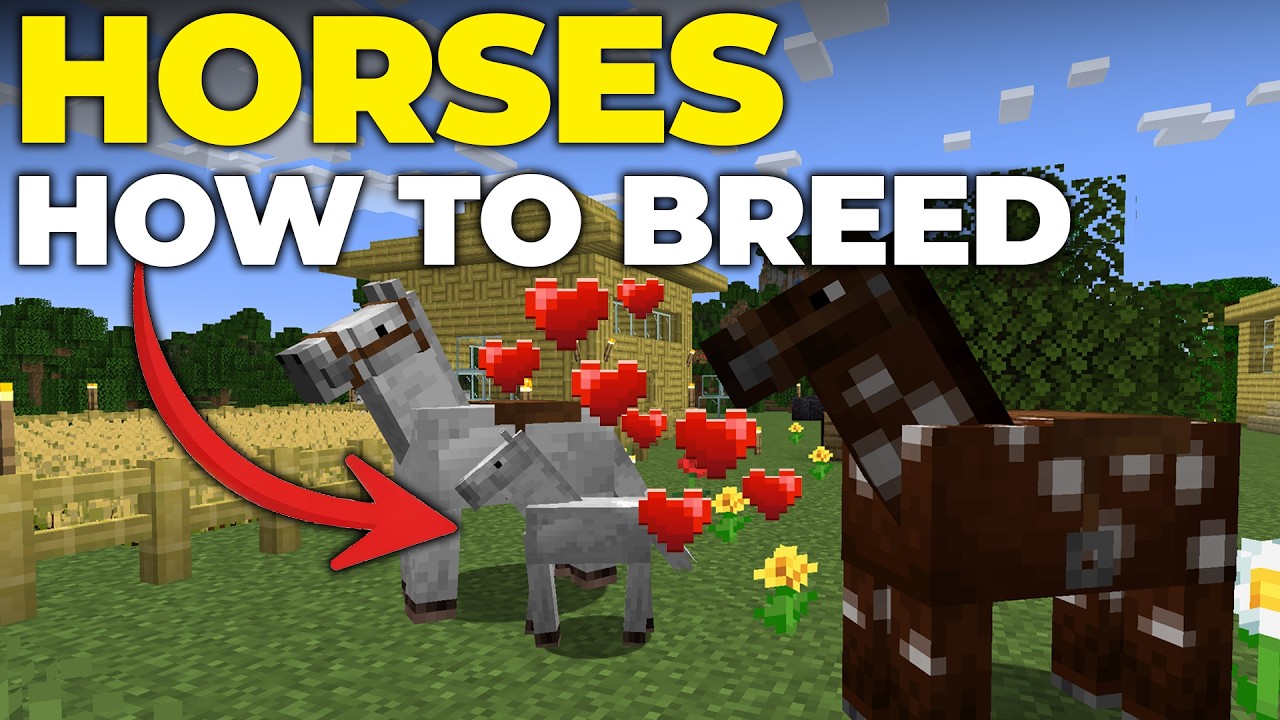
To breed horses, feed both horses a golden apple or a golden carrot. When fed the right item, the horse will enter “love mode,” visually indicated by red heart particles floating above its head.
Once both horses are in love mode and are near each other, they’ll approach one another and produce a foal.
Breeding Cooldown
After breeding, horses can’t breed again immediately — there is a cooldown period before either parent can be bred again. This prevents you from spamming golden apples and instantly producing dozens of foals. Just feed them again once the cooldown wears off if you want another foal from the same pair.
Foal Growth
The foal starts as a baby and takes time to grow into an adult. You can speed this up by feeding it the appropriate food (more on that below), or you can simply wait it out. Baby horses cannot be ridden until they mature, though you can still interact with and feed them.
Step 5: How Stat Inheritance Actually Works
This is the part that separates casual horse owners from serious horse breeders.
When two horses breed, the foal’s stats (health, speed, and jump strength) are calculated using one of three possible methods, chosen somewhat randomly for each individual stat:
- Average of both parents — the foal’s stat is the midpoint between mom and dad
- Slightly above the average — the foal gets a small random bonus above the midpoint
- Slightly below the average — the foal gets a small random penalty below the midpoint
This calculation happens independently for each of the three stats. So a foal might inherit above-average speed, average health, and below-average jump strength, all from the same pair of parents.
Why This Matters for Breeding Strategy
Because of this system, if you consistently breed your two best horses together, and then breed the best foals from that pairing with each other, you gradually push the stats of your herd upward over generations. This is exactly how real-world animal breeding programs work, and Minecraft models it in a simplified but genuinely functional way.
The Golden Rule of Breeding
Always breed your best-performing horses with each other, and cull or repurpose the weaker ones. Over several generations, this will produce horses with near-maximum stats across the board.
If you’re a completionist, here’s the general approach top players use:
- Tame a large batch of wild horses (ten or more, if you can find them).
- Compare their speed and jump height through informal races and jump tests.
- Identify your top two or three performers.
- Breed those together repeatedly, always saving the best foals and letting go of (or using for leather/mule breeding) the weaker ones.
- Repeat this process over multiple generations until you’re satisfied with your herd’s overall quality.
This does take real time and effort, but the payoff is a horse that outruns and outjumps almost anything else in the game.
Step 6: Feeding Horses (Beyond Breeding)
Golden apples and golden carrots aren’t the only food horses eat, and understanding the full food list helps you raise foals faster and keep your horses healthy.
Foods Horses Can Eat
- Wheat – speeds up growth for foals
- Sugar – speeds up growth for foals
- Apples – speeds up growth, minor healing
- Hay bales – heals adult horses and speeds up foal growth significantly
- Golden carrots – triggers love mode, heals, speeds up growth
- Golden apples – triggers love mode, heals, speeds up growth
Best Use Cases
- If you want to grow a foal into an adult as quickly as possible, hay bales are your best bet since they provide the largest growth boost per feeding.
- If you’re trying to heal an injured horse without wasting a golden apple, wheat or hay bales are more resource-efficient.
- Save your golden apples and golden carrots specifically for triggering breeding, since they’re more resource-intensive to make (gold ingots or gold nuggets are needed for both).
Breeding Donkeys and Mules
Horses aren’t the only equine option in Minecraft. Donkeys exist too, and while they can’t be bred with each other to create anything special (a donkey plus a donkey just makes another donkey), crossing a horse with a donkey produces a mule.
Why Bother With Mules?
Mules can’t breed further (they’re a genetic dead end, just like in real life), but they have a few advantages:
- They can carry a chest, giving you extra inventory space while riding, which horses cannot do
- They’re often sturdier for pack-animal purposes if you’re transporting large amounts of cargo across the map
The tradeoff is that mules cannot be equipped with horse armor and generally aren’t as fast as a well-bred horse, so most players use mules specifically for hauling goods rather than pure transportation speed.
Step 7: Horse Armor and Customization
Once you’ve bred your ideal horse, you’ll probably want to gear it up.
Horse Armor Types
Horse armor comes in several tiers, similar to player armor:
- Leather (craftable, provides the least protection)
- Iron
- Gold
- Diamond (the best protection available)
Simply open the horse’s inventory (after saddling it) and place the armor in the designated armor slot. This protects your horse from damage in combat, which is especially useful if you’re bringing your horse into dangerous areas like Nether transportation networks (with appropriate precautions) or PvP-adjacent combat zones.
Saddling
Don’t forget — a horse cannot be ridden and steered without a saddle. Saddles cannot be crafted in vanilla survival; you’ll need to find one in a chest (village stables, dungeons, or similar loot locations) or trade for one with a leatherworker villager.
Common Mistakes to Avoid
Even experienced players trip up on a few common horse-breeding pitfalls. Here’s what to watch for:
Breeding Randomly Without Tracking Stats
If you breed horses at random without paying attention to speed and jump comparisons, you’ll end up with a herd of mediocre horses. Take the time to actually test and compare your horses before deciding who breeds with whom.
Losing Track of Which Horse Is Which
Once you have a dozen brown horses running around a pen, it’s easy to lose track of your best performers. Consider using name tags to label your top breeding horses so you don’t accidentally cull the wrong one.
Not Building a Proper Pen
Horses (and foals especially) can wander off if left unfenced, and a foal that wanders away and despawns before maturing is a heartbreaking loss. Build a secure fenced area with at least a two-block-high fence (or fence gates) before you start any serious breeding operation.
Forgetting the Cooldown
New players sometimes assume they can chain-breed a horse repeatedly. Remember that each horse needs a cooldown period before it can breed again, so plan your breeding sessions accordingly, especially if you’re trying to run multiple pairings in the same session.
Ignoring Donkeys and Mules Entirely
Many players never bother with mules since they can’t be bred further, but if you frequently transport large quantities of items across long distances, a chest-carrying mule can genuinely save you time and inventory headaches.
Advanced Tip: Speed-Running the Breeding Process
If you’re an efficiency-focused player, here’s a streamlined approach to get a top-tier horse as quickly as possible:
- Locate a large plains or savanna biome with a substantial horse population — the more horses you can tame initially, the larger your genetic pool to select from.
- Build your pen first, before taming anything, so you have somewhere secure to herd tamed horses immediately.
- Tame in bulk. Don’t stop at two or three horses — tame as many as you reasonably can, since a larger sample size means a better chance of finding naturally high-stat horses to start with.
- Test speed and jump height informally. Set up a simple straight-line track and a series of fence-height obstacles, then ride each horse through them to get a rough sense of their stats.
- Breed only the top performers, feeding excess horses to reduce pen clutter (or keep a few for leather production down the line).
- Use hay bales to accelerate foal growth, so you’re not waiting around in real time for foals to mature.
- Repeat for two or three generations. By generation three, you should have horses with noticeably superior speed and jump height compared to your starting stock.
This process takes some patience, but it’s genuinely one of the more rewarding long-term projects in Minecraft survival mode, especially if you’re playing on a large map where fast travel actually matters.
Frequently Asked Questions
Can I breed a horse with a donkey to get another donkey? No. Breeding a horse and a donkey always produces a mule, not another donkey or horse.
Do horse colors affect stats? No. Coat color and pattern are entirely cosmetic and have no bearing on health, speed, or jump strength.
Can zombie horses or skeleton horses be bred? No. These are special variants obtained through rare spawns or specific summoning conditions, and they cannot be bred using the standard system.
How long does it take for a foal to grow up? Left alone, it takes a while in real time, but feeding it hay bales, wheat, sugar, apples, golden carrots, or golden apples will speed up the process considerably.
Is there a maximum stat cap for horses? Yes. Health, speed, and jump strength all have hard-coded maximums, so even with perfect breeding, you won’t get infinitely better horses — you’ll eventually hit the game’s built-in ceiling for each stat.
Final Thoughts
Horse breeding in Minecraft is one of those systems that seems simple on the surface — feed two horses a golden apple, get a baby horse — but has surprising depth once you dig into the stat inheritance mechanics. Whether you’re a casual player who just wants a slightly faster ride to the village, or a completionist chasing max-stat horses across multiple breeding generations, understanding how taming, feeding, and inheritance work will make your entire Minecraft experience smoother.
Build a solid pen, tame a wide variety of horses, pay attention to speed and jump performance, and be patient with the selective breeding process. Before long, you’ll have a stable full of horses that make every other form of transportation in the game feel slow by comparison.
Happy breeding, and enjoy the ride.

Alex Smith
I’m a dedicated gamer who loves exploring games, mastering gameplay mechanics, and sharing gaming knowledge. I stay updated with the latest releases, tips, and strategies to improve performance and enjoyment. Gaming is my passion and my skill.