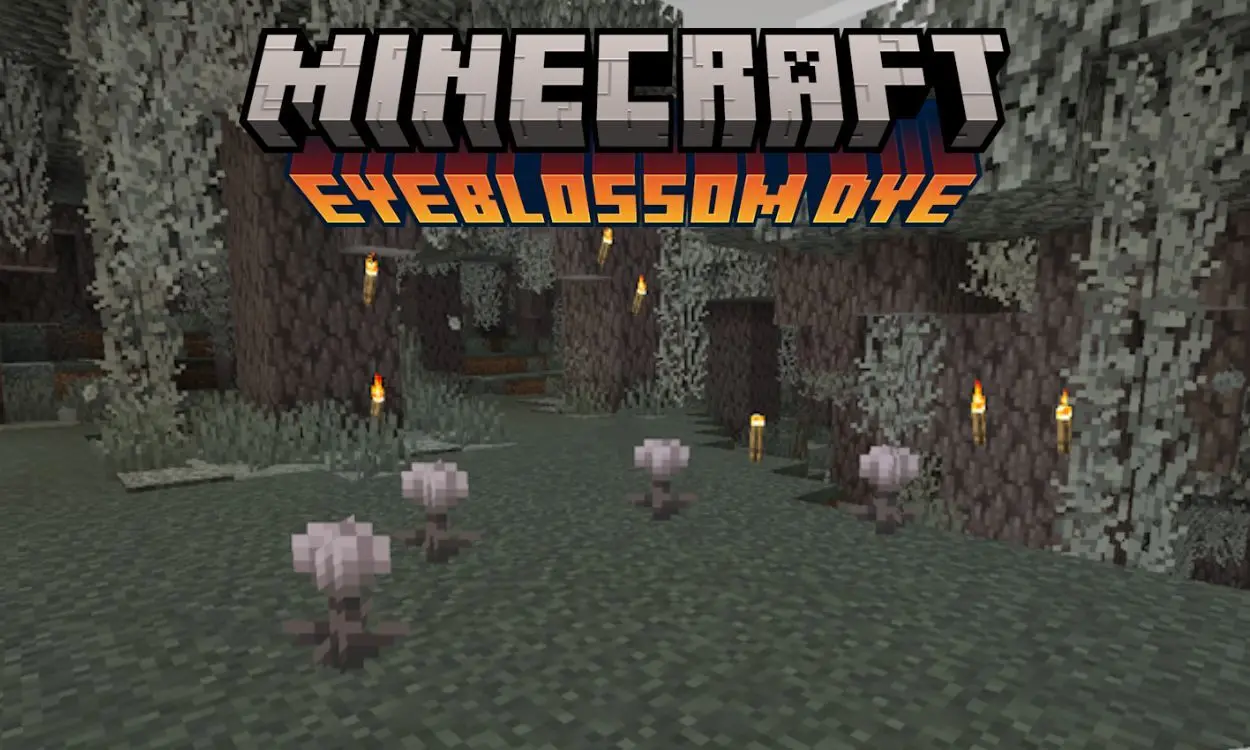
Minecraft’s Pale Garden update brought us a lot of spooky new toys to play with, and one of the most interesting is a flower that doesn’t behave like anything else in the game: the Eyeblossom. It looks unsettling, it “talks” to other flowers nearby, and — most useful for builders and decorators — it can be turned into two completely different dye colors depending on when you pick it.
If you’ve wandered into a Pale Garden and seen these strange, eye-like blooms glowing in the dark, you’re probably wondering how to actually turn them into usable dye. This guide walks you through the entire process, from finding the Pale Garden biome to harvesting the flowers at the right time and crafting them into orange or gray dye you can use on wool, banners, beds, candles, and more.
What Is Eyeblossom Dye, Anyway?
Before we get into the how-to, it helps to understand what makes Eyeblossoms different from every other flower in Minecraft.
Most flowers in the game only produce one color of dye, no matter when you pick them. A poppy always gives red dye. A dandelion always gives yellow dye. Eyeblossoms break that rule entirely. They’re the first flower in Minecraft with two distinct states — open and closed — and each state produces a different dye:
- Closed Eyeblossom (daytime state): produces gray dye
- Open Eyeblossom (nighttime state): produces orange dye
This day/night mechanic means you genuinely have to plan your harvesting trips around the in-game clock if you want a specific color. It’s a small detail, but it makes Eyeblossoms feel more alive than your average patch of tulips.
On top of the color-shifting mechanic, Eyeblossoms also glow faintly when open, release particles that cause nearby Eyeblossoms to open or close in sync with them, and are mildly poisonous to bees on contact. They’re clearly designed to reinforce the eerie, unsettling vibe of the Pale Garden biome they call home.
Where to Find Eyeblossoms
Eyeblossoms are not scattered randomly across the Overworld the way daisies or dandelions are. They only naturally spawn in one place.
The Pale Garden Biome
Eyeblossoms are exclusive to the Pale Garden, a dark, foggy biome that was added alongside the Creaking mob. If you haven’t encountered it yet, here’s what to expect:
- Low visibility. The Pale Garden is thick with fog, which limits how far you can see and adds to the tension of exploring it.
- Pale Oak trees. These bone-white trees with hanging pale moss and pale hanging vines make up most of the biome’s canopy.
- The Creaking. A new hostile mob that only spawns in this biome (and only at night, or in the dark), tied thematically to the Pale Garden’s unsettling atmosphere.
- Ground cover. Eyeblossoms typically generate in patches on grass blocks throughout the biome, often near the base of Pale Oak trees.
Pale Gardens tend to generate near or bordering Dark Forest biomes, so if you’re searching manually, Dark Forests are a good area to start scanning around.
Locating the Biome Faster
Exploring on foot can take a while, especially since Pale Gardens aren’t the most common biome. A few tips to speed things up:
- Use a locate command (Java Edition, if commands are enabled). Typing
/locate biome minecraft:pale_gardenwill point you toward the nearest one. - Check biome finder websites or seed maps if you already know your world seed.
- Travel along Dark Forest edges. Since the two biomes are related, skirting the borders of a Dark Forest can lead you straight into a Pale Garden.
- Bring a boat or horse. These biomes can be a fair distance from spawn, so faster travel saves a lot of time.
Before heading in, gear up. While the Pale Garden isn’t the most dangerous biome in the game, low visibility plus a new mob means it’s smart to bring food, a weapon, and a few torches or a light source, even though the Creaking has some unique rules around light and combat.
Understanding the Open and Closed States
This is the part that trips up a lot of players, so it’s worth spelling out clearly.
Eyeblossoms are tied to the same day/night cycle that governs mobs and villager behavior. Their appearance and their harvestable dye color change automatically:
- During the day, Eyeblossoms sit closed and appear gray and unassuming. In this state, they blend in more with the misty surroundings.
- At night, Eyeblossoms open up, revealing a glowing orange “eye” at the center that gives off a dim light. Open Eyeblossoms also periodically release particles that can trigger nearby Eyeblossoms to open as well, creating a kind of chain reaction across a patch of flowers.
Because the flower’s block state actually changes with the time of day (rather than just its texture shifting), what you harvest depends entirely on when you pick it:
- Harvest during the day → get a Closed Eyeblossom → crafts into gray dye
- Harvest during the night → get an Open Eyeblossom → crafts into orange dye
One quirk worth knowing: on Bedrock Edition, Eyeblossoms generate in the closed state regardless of the time of day when they first spawn, even if it’s nighttime. They’ll still open up once night falls and the game ticks their state, but don’t be surprised if a freshly-generated patch looks closed even under a dark sky. On Java Edition, they generate matching whatever time of day it currently is.
If you only want one specific dye color, plan your trip accordingly. Want gray dye? Head into the Pale Garden during daylight hours. Want orange dye? Wait until nightfall, or simply hang around in the biome until the sun sets.
Step-by-Step: How to Harvest Eyeblossoms
Here’s the full process broken down into simple steps.
Step 1: Travel to a Pale Garden Biome
Using the tips above, make your way to a Pale Garden. Bring basic survival gear — food, a weapon, and maybe some blocks to build a quick shelter if you plan on waiting through a day/night cycle.
Step 2: Decide Which Dye You Want
Check the in-game clock (or just look at the sky) and decide whether you’re harvesting during the day for gray dye or at night for orange dye. If you want both colors, you can simply harvest some flowers now and wait around for the cycle to flip before harvesting more.
Step 3: Pick the Flowers
Approach a patch of Eyeblossoms and interact with them to collect them. A few harvesting notes:
- Bare hands or shears both work. Unlike some plants, you don’t need a special tool to break an Eyeblossom.
- Using shears (or a tool with Silk Touch) preserves the current state of the flower when it drops, so you get exactly the version you’re looking at — open or closed.
- Watch your step around bees. Open Eyeblossoms are mildly toxic to bees on contact, so if you’re farming near a bee nest or you brought bees along for a nearby garden, keep them away from open blooms.
Step 4: Consider Farming Options
If you plan on needing a lot of Eyeblossom dye — say, for a big banner project or an entire dyed-wool build — picking flowers one at a time can get tedious. A few ways to speed up collection:
- Bone meal. Applying bone meal to grass blocks within the Pale Garden has a chance to spawn additional Eyeblossoms nearby, letting you expand a patch instead of hunting for new ones. On Bedrock Edition, you can also apply bone meal directly onto an existing Eyeblossom to spread more copies to adjacent grass blocks.
- Water or piston-based auto-farms. Since Eyeblossoms behave like other flowers when it comes to being broken by flowing water or by pistons, you can build a small automated collection system: a water channel that sweeps broken flowers into a hopper, or a piston set up to knock flowers loose so they drop as items.
- Villager trading. Wandering Traders occasionally sell Open Eyeblossoms for one emerald each. This is a handy backup if you can’t easily get to a Pale Garden, though note that traders only sell the open variety — you won’t find closed ones in their inventory.
Step 5: Head to a Crafting Table
Once you’ve got a stack of Eyeblossoms (open, closed, or both), find or place a crafting table. This next part is refreshingly simple.
How to Craft Eyeblossom Dye
Unlike a lot of Minecraft recipes, turning an Eyeblossom into dye doesn’t require any specific pattern or additional ingredients. It’s a 1-to-1 conversion.
Crafting Gray Dye
- Open your crafting table.
- Place a Closed Eyeblossom into any empty slot in the crafting grid.
- Collect the gray dye that appears in the output slot.
Crafting Orange Dye
- Open your crafting table.
- Place an Open Eyeblossom into any empty slot in the crafting grid.
- Collect the orange dye that appears in the output slot.
That’s it — no combining with other items, no shapeless pattern to memorize. One flower goes in, one dye comes out. Because the recipe is shapeless, you can even toss a handful of Eyeblossoms into a crafting grid at once and pull dye out repeatedly without rearranging anything.
What Can You Do With Eyeblossom Dye?
Once you’ve got a stockpile of orange and gray dye, you can use it just like dye from any other source. Some popular uses include:
- Dyeing wool and terracotta for builds that want a muted, natural gray or a warm, autumnal orange.
- Coloring carpets and beds to match a room’s theme.
- Dyeing candles for lighting that fits a cozy or eerie aesthetic (fittingly, given where the flower comes from).
- Creating and coloring banner patterns, which is especially handy if you’re building a Pale Garden or Dark Forest-themed base and want banners that match the environment.
- Dyeing leather armor or shulker boxes, if you want your gear or storage to stand out with these slightly unusual colors.
Because Eyeblossom dye produces the same gray and orange as other dye sources, it blends seamlessly into any project — it’s just a more atmospheric way to get there if you enjoy exploring the Pale Garden.
Other Ways to Get Orange and Gray Dye
If you’re not fussed about using Eyeblossoms specifically and just need the colors, there are plenty of alternative routes:
Alternative Orange Dye Sources
- Orange tulips, found in flower forests and plains, craft directly into orange dye.
- Torchflowers also produce orange dye when crafted.
- Combining red dye and yellow dye in the crafting grid produces two orange dye at once.
Alternative Gray Dye Sources
- Combining black dye (or an ink sac) with white dye (or bone meal) in the crafting grid yields two gray dye.
- Wandering Traders occasionally sell gray dye directly, typically a few units for the price of an emerald.
These alternatives are useful if you’re nowhere near a Pale Garden or just want a faster source while you’re focused on other projects.
Bonus: Other Uses for Eyeblossoms Besides Dye
Dye isn’t the only thing Eyeblossoms are good for. If you pick up extra flowers, here’s what else you can do with them:
Suspicious Stew
Eyeblossoms can be used as an ingredient in Suspicious Stew, and true to their unsettling theme, the effects aren’t exactly pleasant:
- A Closed Eyeblossom in Suspicious Stew grants a Nausea effect.
- An Open Eyeblossom in Suspicious Stew grants a Blindness effect.
These aren’t buffs you’ll want under normal circumstances, but they can be useful for pranking friends on a multiplayer server, or for niche redstone/status-effect builds where inflicting Blindness or Nausea on a mob or player is actually the goal.
Composting
Like most flowers, Eyeblossoms can be tossed into a composter. They have a solid chance of filling the composter by one level each time, making them a decent way to generate bone meal if you’re running low, especially since you’re likely to end up with a surplus of flowers after a big harvesting trip.
Decoration
Don’t underestimate the simple visual appeal of Eyeblossoms. Their glowing, eye-like center and color-shifting nature make them a striking decorative plant on their own, without ever needing to craft them into dye. Potted Eyeblossoms are a great option too — they still shift between open and closed states over time, adding a bit of subtle animation to interior builds, gardens, or Pale Garden-themed rooms. Just keep in mind potted Eyeblossoms only change state when they receive a random tick and can’t sync up with nearby flowers the way ground-planted ones can.
Quick Recap
To summarize the whole process:
- Find a Pale Garden biome — it’s the only place Eyeblossoms naturally spawn, usually near Dark Forests.
- Decide on a dye color — day for gray, night for orange, since the flower’s state changes with the time of day.
- Harvest the flowers — bare hands or shears both work; shears (or Silk Touch tools) lock in the current state.
- Craft at a table — place a single Eyeblossom in any crafting grid slot to get one dye of the matching color.
- Use the dye — wool, carpets, beds, candles, banners, and more all accept it just like any other dye.
Eyeblossoms are a great example of how Minecraft keeps finding small, clever ways to make everyday systems like dyeing feel a little more dynamic. Between the day/night mechanic, the eerie glow, and the Pale Garden setting they call home, they’re worth the trip even if you’re only after a stack or two of dye. Grab some shears, time your visit right, and you’ll have both orange and gray dye in your inventory before you know it.

Alex Smith
I’m a dedicated gamer who loves exploring games, mastering gameplay mechanics, and sharing gaming knowledge. I stay updated with the latest releases, tips, and strategies to improve performance and enjoyment. Gaming is my passion and my skill.